



Choosing the Right Transfer and Pump Tubing for Your Pharmacy

Pharmacy tubing plays a role in everything from transferring diluent to filling syringes and IV bags. The right set needs to match your pump, solution, and connections so it fits the way your pharmacy works.
Whether you’re reordering a familiar item or considering an alternative, a few details can help you narrow the options. Come along with us, as we explore the necessary steps when making your next tubing purchase for your pharmacy.
Start With the Application

Pharmacy transfer tubing moves fluid between containers during medication preparation. Depending on the set, it can support manual transfer with a syringe or work with a compatible pharmacy pump.
Pharmacy pump tubing is designed for specific compounding or dispensing equipment. These sets may include a pump segment, source-container connections, clamps, and an outlet for filling syringes, IV bags, or other containers.
IV extension and administration sets serve a different role in patient delivery. Always check the intended use. Tubing used to prepare or fill a medication container is not automatically suitable for administering it to a patient.
Match Pump Tubing to Your Equipment
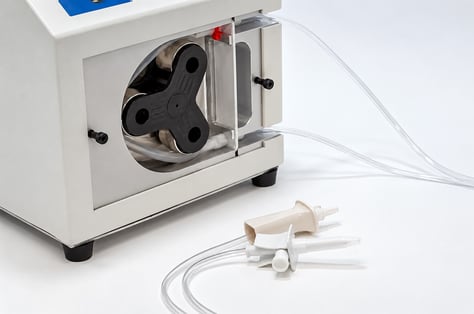 In a peristaltic pump, rollers compress and release the tubing to move liquid. The tubing is part of the pumping mechanism, and its dimensions, material, and ability to recover after compression affect performance.
Inner diameter, outer diameter, and wall thickness all matter. Similar-looking sets can have different specifications, so a physical fit alone does not confirm compatibility.
Start with your pump’s manufacturer and model, along with the tubing part number you currently use. Check the proposed set’s compatibility documentation and the pump’s instructions. Confirm any setup, calibration, or verification requirements before making a change.
What to Check Before You Order
-
Connections and Configuration
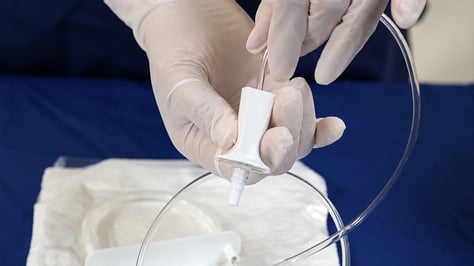
Check the connections at both ends of the set. Your application may call for a vented spike, male or female Luer connection, or a configuration for filling oral dispensers. Single-, dual-, and triple-spike options are available within some pump tubing families.
Match the connections and number of source leads to your containers and process. Confirm venting requirements as well. A “universal” spike describes that component; it does not make the entire set compatible with every pump.
-
Materials and Solution Compatibility
Review the materials throughout the fluid path. Some sets combine a silicone pump segment with non-DEHP PVC tubing elsewhere. A silicone insert does not make the whole set silicone, and DEHP-free does not mean PVC-free.
The solution matters, too. Compatibility depends on the formulation, concentration, temperature, and contact time. Use manufacturer documentation and your pharmacy’s review process to confirm suitability. General chemical compatibility charts are a starting point, not proof that a set is suitable for every medication.
-
Length and Priming Volume
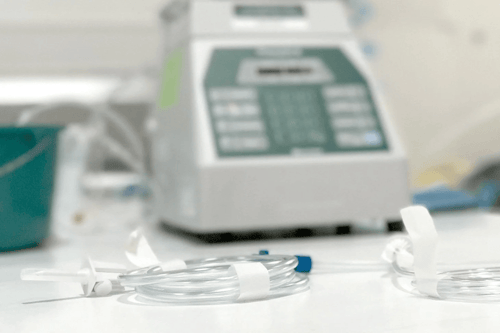
Choose a length that works for your setup and check the set’s priming volume: the amount of fluid needed to fill it. That volume deserves attention when you’re working with costly solutions.
Compare the manufacturer’s stated priming volume for the complete set. Length alone does not tell you how much fluid it holds. If you’re considering a low-priming-volume option, confirm that it meets the requirements of your pump and application.
-
Sterile Packaging and Handling
For applications requiring a sterile fluid path, check the sterile labeling, package integrity, expiration information, and handling instructions. Appropriate aseptic technique is still required when opening the set and making connections.
Tubing selection is one part of a sterile compounding process. Maintaining the practices and conditions addressed by USP <797> requires attention to the full preparation process, including how supplies are handled and used.
-
Replacement and Calibration Requirements
Follow the instructions for your specific pump and tubing set. Review replacement limits, requirements when changing liquids, and any calibration or verification steps. Build those requirements into your procedures, including the restrictions for products labeled for single use.
-
Consider the Full Cost
After confirming compatibility, consider what the set costs to use. Priming volume, additional connectors, replacement requirements, and package quantities all belong in that comparison.
If you switch products, update your approved item list and staff instructions. Keep the part number, pump model, connection details, package quantity, and supplier together in your purchasing records. Clear reorder information gives your team a consistent reference for future purchases.
Find Pharmacy Tubing From CPSI
CPSI offers tubing for pharmacy preparation, fluid transfer, and IV extension applications. Options include:
- MPS G827 Series Repeater Pump Tubing Sets are available in multiple connection configurations for Baxter REPEATER compounding pumps.
- TrueCare PharmAssist-Compatible Solution Transfer Tubing, TCBPTTPS1, is designed for high-volume use with the Excelsior PharmAssist pump.
- B. Braun MULTI-AD Vented Transfer Set supports syringe-operated dispensing of IV additives with a two-way valve assembly and universal spike.
Send CPSI your current tubing part number, pump model, connection requirements, and estimated monthly usage. We can help you review available options and get the product information your pharmacy needs to make a decision.
Shop ALL pharmacy tubing and pump tubing at CPSI.
Our featured tubing partner for November is MPS Pharma! For a LIMITED TIME, save 5% on your next order of any MPS Pharma products!
Use Code: BEYONDTUBING
Delivering Compliance.
📞 888-787-5185
📧 customerservice@cpsi2.com
🔍 Check out all our pharmacy tubing solutions HERE!